
By Ned Rozell
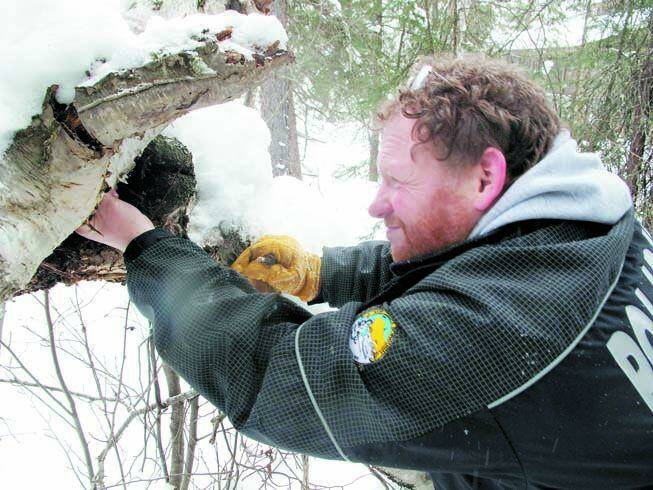
A few winters ago, Todd Sformo was out gathering hibernating insects from the woods near the Fairbanks International Airport. He searched for dead balsam poplar trees, looking for a beetle that spends its winters under the loose bark, exposed to the frigid air.
When he found a few of the beetles and placed them in plastic containers, he noticed thousands of wispy flies sharing space beneath the bark. He collected a few of them, even though he wasn’t sure what they were. He had a few spaces available in a cooling chamber he was using to check the cold tolerance of the beetle, so he thought, “Why not test the mystery insect, too?”
As sometimes happens in science, that chance decision led to a discovery. The second bug, a fungus gnat, survives the winter by allowing half of its body to freeze. The other half, including its head, stays thawed.
“It’s simultaneously freeze-tolerant and freeze-avoiding,” said Sformo, who earned his doctorate at the University of Alaska Fairbanks’ Institute of Arctic Biology in the lab of Professor Brian Barnes. Sformo now works as a biologist with the North Slope Borough in Utqiaġvik.
Most insects that live this far north use one of two strategies to endure the frigid air of an Alaska winter. They either allow their bodies to freeze, removing water from within their cell walls to prevent ice crystals from puncturing them, or they flood their bodies with their own varieties of antifreeze before the cold air oozes over Alaska.
The fungus gnat Exechia nugatoria does both.
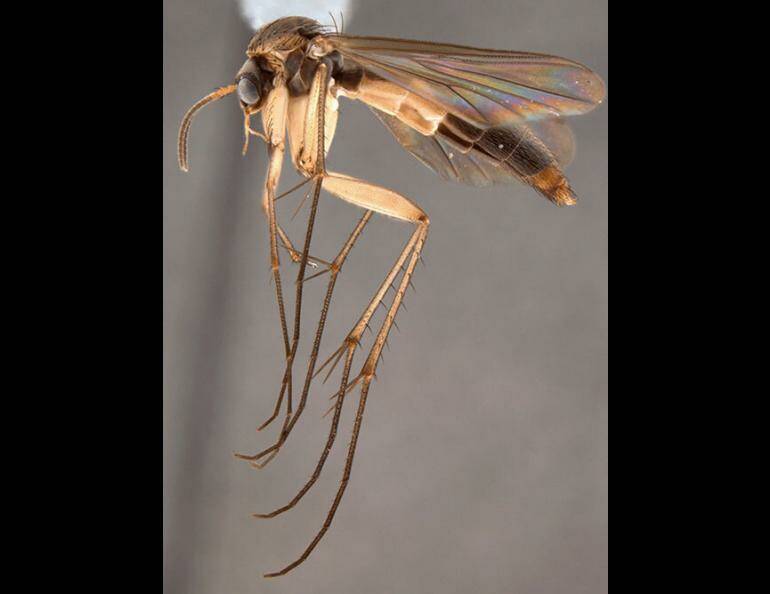
Photo by Peter H. Kerr, California Department of Food and Agriculture The fungus gnat Exechia nugatoria.
Sformo uncovered the fungus gnat’s secret while he studied the red flat bark beetle’s incredible resistance to freezing, which shares the fungus gnat’s wintering tree. Sformo and others found that the red flat bark beetle could withstand minus 240 degrees Fahrenheit without perishing. That is a bit of a head-scratcher when you consider the lowest temperature ever recorded on the planet was minus 129 degrees Fahrenheit. Why would a creature invest energy in a mechanism that protects itself from air that cold?
In the lab, Sformo placed the fungus gnats in the same deep-freeze solution into which he lowered the beetles. He chilled the insects until they gave off a spike of heat, an indicator of freezing.
Because he was testing the fungus gnats in the same bath as the red flat bark beetles, Sformo lowered the temperature to an extreme of about minus 100 degrees Fahrenheit.
To his surprise, Sformo found the fungus gnats showed two distinct freezing events, as if different parts of their bodies were freezing at different temperatures.
One part was freezing at about minus 25 degrees Fahrenheit, and something else within them froze at minus 60 degrees below zero. When he warmed the insects back up from minus 25 degrees, most of them came back to life. None survived after dropping to 60 degrees below zero.
Adult fungus gnats look sort of like mosquitoes, with a head and chest (thorax) up front, and a cigar-shaped abdomen behind. Sformo wanted to see if a certain part was freezing before the other, so he snipped in half several fungus gnats.
He found that the abdomens froze at minus 25 degrees Fahrenheit, while the heads resisted freezing until temperatures got to 60 degrees below zero.
Why would a creature allow part of its body to freeze, but not the other? Sformo wasn’t sure, but maybe having part of its body frozen allows a fungus gnat to lose less body moisture to evaporation during the long winter.
Sformo knows a few things about the fungus gnat now—that the insect is surviving cold air like no other known insect, and that some of the most intriguing discoveries in science happen when you are looking for something else.
• Since the late 1970s, the University of Alaska Fairbanks’ Geophysical Institute has provided this column free in cooperation with the UAF research community. Ned Rozell is a science writer for the Geophysical Institute. A version of this column appeared in 2009.
