
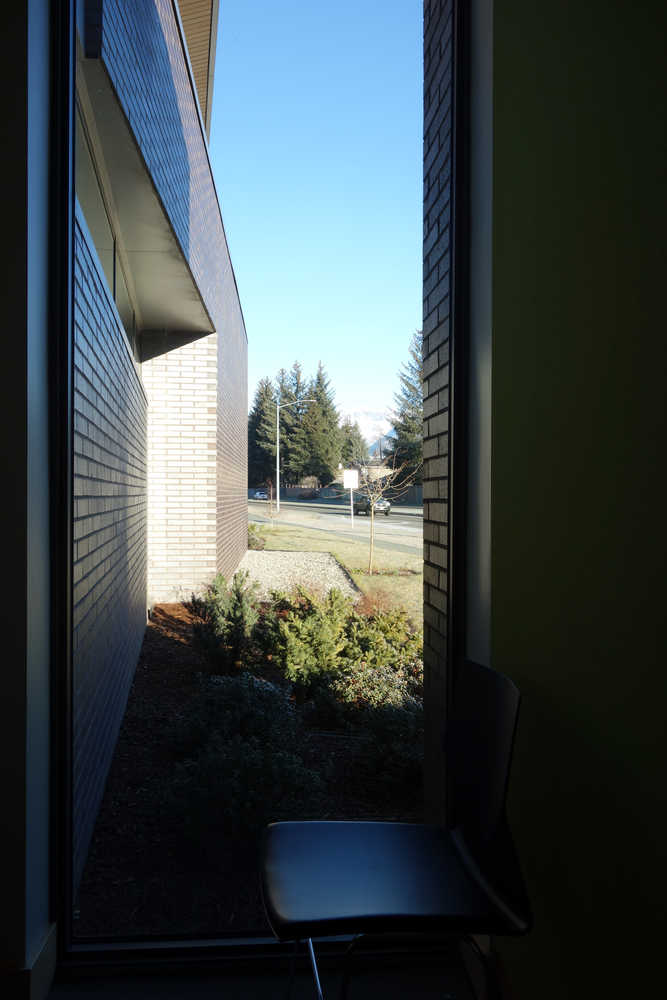
As I sit here at the Mendenhall Valley Public Library on a Saturday, the frost outside the window sparkling in rare Juneau sunshine, I think of the thousands of people around the world who are choosing to stay indoors as they write their novels. It’s National Novel Writing Month, and participants are trying to write 50,000 words between midnight Nov. 1 and 11:59 p.m. Nov. 30. It certainly isn’t a small undertaking, but I am reminded of something a university classmate of mine said to me years ago: “Writers write.”
It isn’t something nobody has never said before — actually, it’s obvious when you think about it. But when I first heard it, it cut through my writing excuses and made me seriously reevaluate my relationship with my creative work. It helped jump start a writing habit that I kept to for almost two years, and even gave me motivation to participate in NaNoWriMo multiple times.
I had been riding Capital City Transit on the way to the University of Alaska Southeast Juneau campus and this classmate and I were discussing writing. I can’t recall exactly how we’d gotten to this point in our conversation, but I must have made some comment about being too busy to write. He chuckled and said “writers write” like it was obvious.
It should have been, but at that moment it was like a revelation. How can I call myself a writer if I don’t take the time to write?
All the reasons I didn’t write seemed pathetic as they rested on my tongue. I swallowed them and seriously considered what he said. I was embarrassed, mainly because I knew he was right. I didn’t write as much as I wanted to or knew I should. It had been a frustration of mine. Going to school full time and working two part-time jobs didn’t leave me an abundance of free time. When I did, I often got writers’ block, a blanket term I and others like to use when we don’t feel like writing, a phenomenon which usually stems from deeper issues than the Muse packing its bags to go live in what we imagine to be another writer’s worthier mind.
Something I’ve come to learn in recent years is that writers’ block comes from a variety of places and takes on different forms, but it usually stems from fear. I’m talking about fear of failure; fear that our craft, ideas and stories aren’t good enough; fear that no one will want to read what we write; fear that we’re wasting our time; fear that our stories won’t translate to the page as well as they manifested in our brains; fear that our work won’t ever even be a smidgen as lyrical, imaginative or compelling as those of our favorite writers. We make excuses or find other projects, like cleaning the bathroom or organizing our book shelves, and promise ourselves later, tomorrow, someday. Well, “someday” keeps getting pushed back. Months turn into a year and what do we have to show for the time besides a few pages with openings written and rewritten again. Writers’ block is often an excuse, I’ve learned, that keeps us from looking too closely at what’s keeping us from writing.
If you participate in National Novel Writing Month, you don’t have time for writers’ block. To reach your 50,000 word goal, you have to write at least 1,667 words a day.
Now I didn’t immediately jump into NaNoWriMo. I started writing on 750words.com (recommended if you want to start a daily writing habit). The site sent me reminder emails, kept track of my word count, and allowed me to achieve streaks, hitting my 750 word count for days in a row. That December, I challenged myself to write every day for the entire month. But once I finished December, I thought, why stop? Once on a streak, I kept going and wrote daily for nearly two years with only the occasional break.
I wrote about my life, wrote school assignments, worked on creative pieces, even wrote about how much I didn’t feel like writing at that moment and explored the reasons behind my blocks through words. I gave myself permission to write with abandon, because after all, no one would be reading these words but me. I learned to silence my inner editor through free-writing. I didn’t allow myself to go back and edit as I went along, or I knew I’d just get hung up on the small things and lose track of what I was trying to write. Rough drafts can be polished later. I learned to not fear a blank page. Eventually I got the courage to finally attempt NaNoWriMo, because I wanted a period of time where I would solely and intensely focus on one project.
The first time I did it wasn’t November, so it technically wasn’t NaNoWriMo, but one August I took the plunge. Feeling wildly accomplished, I did it again that November. And the next year after that, and the one after that.
I won’t pretend NaNoWriMo is easy. It takes a lot of time, energy, and dedication. You must be prepared. Here is what I learned from my experiences. Whether you’re thinking about participating next year, are slugging away at your words currently, or are thinking about doing your own writing challenge on a different month to jump start your novel, hopefully some of this advice works for you.
1. Know what you’re going to write about. This means doing some work before your challenge even begins. I assume you already have a novel you want to write, hence why you’re thinking about participating in NaNoWriMo. I highly recommend writing an outline of your book; mine is usually a basic, general timeline. I like to write down individual scenes on notecards. When I get stuck, I can whip one out and write 1,667 words on that and usually this sparks more ideas so I don’t run out of content.
2. Have a time and space set aside for writing and make it sacred.
For me it means waking up at least an hour and a half to two hours earlier than I wake up to go to work. I go through my regular morning routines, then settle into my recliner with my laptop and notes right beside. I make sure I have everything I need before I begin (tea included, music maybe). I might read a little bit of what I did the day before just to springboard off and then I start writing and don’t stop until I hit my word count. My phone is hidden. I do not go on the internet. I’m focused on the task at hand. If I’m being particularly slow and can’t finish before I have to leave, I will finish when I get home. You know your life — come up with a time and space where you can write and don’t let anything disrupt it. If your house doesn’t provide the quiet you need, try your local library. If you don’t make plans to do your writing, there’s a fair chance you just won’t do it.
3. You’re going to not feel like writing sometimes– write anyways. If you wait for inspiration to strike, like being struck by lightning, you’ll be waiting a long time; it’s an ineffective way to write a novel, which is why you should have a dedicated time and space to write as well as have a plan of what you’re going to write. Often when I don’t feel like writing but make myself do it anyways, I find I start to get into it and enjoy myself and the time slips right by. One of my English professors once said at the start of her class something along the lines of: writing is five percent inspiration and 95 percent perspiration. She was right. Thank you, Ernestine.
4. Don’t edit. If you spend your time editing what you did before, you won’t have as much left to work on writing your 1,667 words. You can edit in December, or whatever month follows the month of your writing challenge. Turn off spell check if the red squiggly lines are bothering you, but keep writing.
5. Be accountable to someone. Tell someone you’re doing the challenge so it’ll be harder for you to back out of it. Maybe do the challenge with some of your writer friends so you can check in on each other’s progress and encourage each other. Check online to see if there are any local NaNoWriMo particpants in your area and see about meeting up for regular write-ins. Or post updates on your progress on social media.
6. You will not have a publishable novel by the end and that’s okay. If it’s anything like mine, it’ll be a jumble of world notes, character motivations, tangled plots threads, and disjointed scenes. I treat it as an immensely rough draft where I’m just trying to get the story and all my ideas down on a Word document. It’s a time where I am learning what my story is, and through the act of writing 50,000 words in a month, I’m much further along with figuring out the details and how everything will connect than if I hadn’t, which brings me to…
7. Redefine your idea of success. I have friends who have participated in NaNoWriMo and didn’t make it to the finish line and then got discouraged. I too missed the mark one year due to a medical emergency and didn’t finish. It was a bit disheartening, but I had to remember I still have thousands of words to show for the time and energy I already spent; there may not be 50,000 of them, but each word still counts. If you worked on your book today, even for a short time, then you have made progress. If for whatever reason you don’t hit your goal, whether it’s 50,000 words or some other writing challenge, you are further along than if you hadn’t tried. You can always try to make that goal next time.
• Contact reporter Clara Miller at clara.miller@juneauempire.com.
