

Dale Pihlman’s first attempt at writing “Alaska’s Inside Passage” didn’t go well.
The Ketchikan retiree just spent the better part of two years putting together a self-published books that’s equal parts memoir and almanac, and it was actually his second try at writing the book.
“I actually started about 15 years ago,” Pihlman said. “I had about 150 pages, and my hard drive crashed. People asked if I had backed it up. I said, ‘Yeah, well, I’ve heard about that, but I had no idea how to do it.’ I printed about half of it, but I was looking over my notes and most of it needed improvements. It was a good start, and it got me thinking about it.”
In retirement, Pihlman said he had plenty of time to think about things he’d learned growing up off the grid north of Ketchikan, crewing a family salmon troller, operating a fishing vessel, spending five seasons as an Alaskan Department of Fish and Game fisheries biologist and operating a vessel sightseeing tours for 23 years.
Pihlman said he wanted the book to be both comprehensive and specific to to the Inside Passage.
“I wrote it for visitors,” he said. “From a practical stand point, it’s one-stop shopping. If you buy ‘Birds of Alaska’ for $25 you might see 20 percent of the birds in the Inside Passage. Also, I think everyone in the panhandle will appreciate the depth of the information of my material. It is a practical guide to marine and terrestrial animals, birds, fish, trees, sea shore animals etc. It has a lot of generally unknown history which I think will be particularly well received as well as a distillation of the complexities of relevant science on subjects such as ecology of the rain forest, plate tectonics and the evolution of salmon.”
A learning experience
Pihlman said he was able to put together most of the book via his files and firsthand experience, but he wrote close to his bookcase, so he could grab books for reference and the internet aided the project too.
That meant sometimes coming across surprising nuggets of information, such as learning that Alaska Packers Association ships used sails for a half-century after the steam engine became popular.
Pihlman was also keen to research the movement of people, which he also found surprising.
“There were people here 5,000 years ago, who just moved on,” Pihlman said. “It’s supported by fact, by evidence and people don’t talk about it. That was fun because it was a learning experience for me.”
Writing “Alaska’s Inside Passage” also changed how Pihlman thinks of missionaries.
“Like a lot of educated people, I guess I thought missionaries came and messed up the Native culture, but it turns out fur traders came first, and they brought alcohol and fire arms,” Pihlman said. “What surprised me is I came away with a more positive feelings about missionaries.”
However, he said that isn’t to say there weren’t some missionaries who demanded forced adoption of European customs with hostile or violent tactics.
“The Presbyterians were pretty demanding — Cut the totem poles down, stop speaking your language, burn your regalia,” Pihlman said.
• Contact arts and culture reporter Ben Hohenstatt at 523-2243 or bhohenstatt@juneauempire.com.
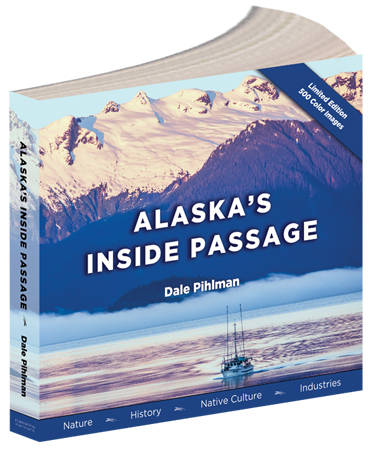
“Alaska’s Inside Passage” by Dale Pihlman is an attempt at a comprehensive and detailed book about about the flora, fauna, people and history of the Inside Passage. (Courtesy photo | Dale Pihlman)
